Pro-regime graffiti in Los Angeles sparks concern in Iranian-American hub
Protect Tehrangeles: Remove IRGC Graffiti
petition for people to sign:
https://influent.me/survey/8e932986-3ad4-440f-a078-485a60b8c9a3
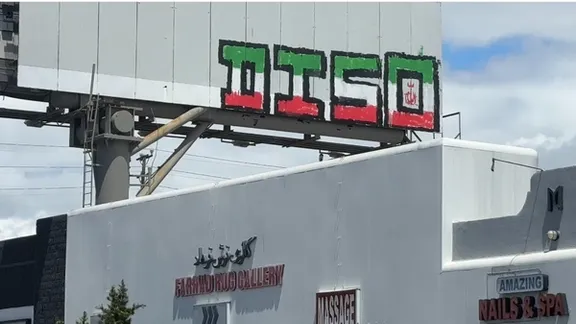
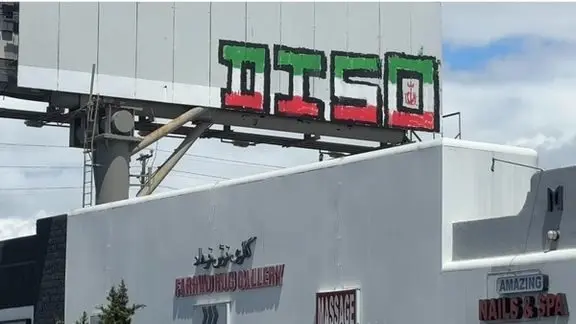
DISO is a Los Angeles-based graffiti group whose work has largely focused on pro-Palestinian and anti-Israel messaging.
Graffiti in support of Iran’s theocracy has appeared in one of the most prominent Iranian-American neighborhoods in the United States, prompting concern among some residents about intimidation and the spillover of political tensions into diaspora communities.
One of the markings found in the area bore the name “DISO,” a Los Angeles-based graffiti group whose work has largely focused on pro-Palestinian and anti-Israel messaging.
The group’s Instagram page includes several posts opposing the US-Israeli war on Iran and expressing support for the Islamic Republic. It has also openly criticized prominent opposition leader and exiled prince, Reza Pahlavi.
The DISO marking was found on a billboard structure along the northbound side of Westwood Boulevard, just north of Missouri Avenue. The graffiti appeared alongside color patterns resembling the flag of the Islamic Republic.
In a separate incident, “Stop War” was spray-painted over photographs of slain Iranian protesters displayed on a nearby memorial wall. There is no evidence that the vandalism of the memorial wall was carried out by DISO.
The wall commemorates protesters killed during a wave of unrest in Iran in January, described by activists as the “Bloody January Massacre”, where at least 36,500 people were killed in the crackdown.
The memorial had become a focal point for collective mourning and political expression among members of the Iranian diaspora, many of whom have called for greater international attention and support following the mass killings.
Its vandalism is viewed by some residents not only as an act of destruction but also as an attempt to undermine or erase a narrative of loss and resistance that holds deep significance for the community.
‘Deliberate act of intimidation’
Despite reports submitted to the City of Los Angeles, some of the graffiti has remained in place, raising questions among residents about response times and local authorities’ handling of politically sensitive vandalism.
Roozbeh Farahanipour, a political activist and member of the West Los Angeles Chamber of Commerce, told Iran International the graffiti represents what he described as a deliberate act of intimidation.
He said the public display of such messaging in Westwood sends what he described as a direct threat by the Islamic Republic and its affiliated networks against the Iranian-American community.
Farahanipour said the imagery reflects an effort by Iranian authorities and their supporters to project power “in the capital of their opposition,” referring to the concentration of Iranian dissidents and exiles in the area.
As an anti-war activist, he added that political activists and business owners in Westwood “will never allow the flag of the Islamic Republic to be displayed or normalized in this community.”
He further characterized the graffiti as a security concern, warning that such messaging, particularly amid ongoing tensions involving Iran, can contribute to fear and intimidation among residents.
For many residents of Westwood, often referred to as “Tehrangeles” because of its large Iranian-American population, the appearance of pro-Islamic Republic messaging carries emotional weight.
The neighborhood has historically served as a refuge for Iranians who left the country after the 1979 revolution and subsequent political repression.

Iran International