
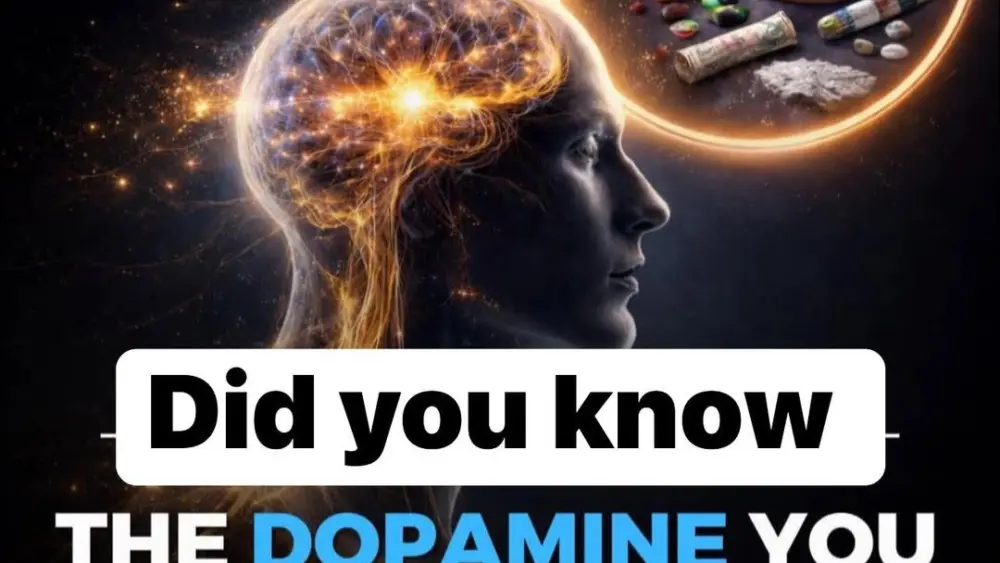
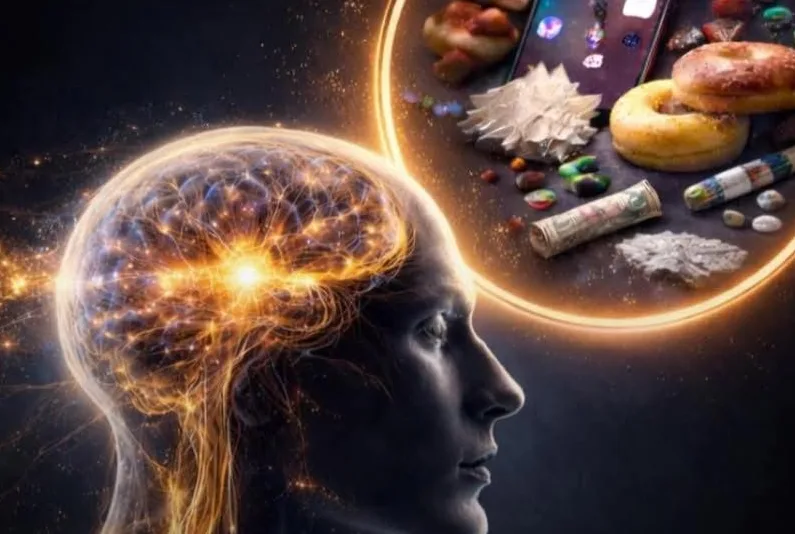
Most people misunderstand dopamine. They associate it with pleasure. In reality, it governs motivation, the internal drive that directs your behavior toward what matters.
When your brain receives dopamine without effort, it encodes a dangerous pattern. It begins to disconnect reward from action. Over time, your drive weakens. Your persistence declines. Even ordinary moments lose their sense of satisfaction.
This is the hidden cost of rapid dopamine sources such as ultra-processed foods, constant scrolling, pornography, drugs, gambling, and instant entertainment. The initial spike feels powerful, but the decline is subtle and cumulative. With repeated exposure, your brain reduces its sensitivity to reward. Motivation drops. Dependence on the same shortcuts increases.
The process is gradual, but the outcome is clear. You feel less driven, less engaged, and less fulfilled.
The encouraging truth is that this system is adaptable. When you shift toward effort-based rewards, your brain recalibrates. Your baseline rises. Motivation strengthens. You begin to experience fulfillment in ways that quick fixes never provide.
The most immediate reward is rarely the most valuable. The rewards that shape a strong, motivated mind are the ones you earn through effort and intention.
Which effortless source of dopamine do you see affecting people the most right now?
Source
Berridge, K. C., & Robinson, T. E. (2016).
Liking, wanting, and the incentive-sensitization theory of addiction.
American Psychologist, 71(, 670–679
Credit to : DrKaveh Elahiyoun